
Math puzzle enthusiasts, rejoice! September 16, 2025, brings another exciting day of Nerdle challenges that will test your numerical prowess and strategic thinking. Whether you’re a seasoned solver or new to the mathematical puzzle phenomenon, this comprehensive guide provides all the solutions and expert strategies you need to conquer today’s Nerdle puzzles.
Nerdle has captivated millions of players worldwide by combining the addictive gameplay of Wordle with mathematical equations. Created by Richard and Imogen Mann, this innovative puzzle game challenges players to deduce hidden mathematical calculations using logic, arithmetic knowledge, and strategic guessing. Unlike traditional word games, Nerdle requires you to think mathematically while applying the same color-coded feedback system that made Wordle famous.
Each day at 12am GMT (4pm PST, 7pm EST), new Nerdle puzzles launch simultaneously across all time zones, creating a global community of math puzzle solvers eager to share their results and strategies.
Understanding Nerdle Game Variations
Nerdle offers four distinct game modes, each designed to challenge different skill levels and time commitments. Understanding these variations helps you choose the perfect puzzle for your current mood and mathematical confidence.
Nerdle Classic represents the flagship experience with eight-character equations that require careful consideration of operations, number placement, and mathematical validity. Players must construct complete equations following standard order of operations while working within the constraint of exactly eight characters.
Nerdle Mini provides a more accessible entry point with six-character equations that typically involve simpler arithmetic operations. This variation appeals to players seeking a quick mental workout without the complexity of longer calculations.
Nerdle Micro offers the most condensed challenge with just five characters, forcing players to think creatively about minimal mathematical expressions. Despite its brevity, Micro puzzles can be surprisingly tricky.
Nerdle Maxi extends the challenge to eleven characters, allowing for more complex equations involving squares, multiple operations, and advanced mathematical concepts. This variation attracts players who crave maximum mathematical complexity.
Nerdle Classic September 16, 2025: Multiplication Mastery
The Solution: 50 * 6 = 300
Today’s Nerdle Classic answer showcases a straightforward multiplication problem that tests your ability to work with larger numbers and recognize common multiplication patterns.
Breaking down the solution step by step reveals several strategic insights. The equation 50 * 6 = 300 demonstrates the power of recognizing number relationships. Fifty represents a round number that frequently appears in mathematical calculations, while six is a single-digit multiplier that creates clean results when paired with multiples of ten.
The result, 300, is a round hundred that should trigger recognition among experienced solvers. When you see patterns involving round numbers like 50 and results like 300, multiplication often provides the connecting operation.
Strategic Approach for Classic Puzzles
Start your Classic attempts by testing equations that include common operations and frequently used numbers. The combination 58-46=12 serves as an excellent opener because it incorporates multiple digits (5, 8, 4, 6, 1, 2) and two operations (subtraction and equals), providing substantial feedback about which elements appear in the target equation.
Pay attention to the relationship between equation length and number size. Eight-character Classic equations often include larger two-digit numbers, making multiplication and division more likely than simple addition or subtraction of single digits.
Nerdle Mini September 16, 2025: Subtraction Simplicity
The Solution: 15 – 6 = 9
The Mini puzzle for September 16 presents a clean subtraction problem that emphasizes the importance of recognizing basic arithmetic relationships.
15 – 6 = 9 represents a fundamental subtraction fact that many solvers should recognize quickly. The equation uses common numbers that frequently appear in elementary mathematics, making it an ideal candidate for early guessing strategies.
This solution demonstrates how Mini puzzles often focus on core mathematical facts rather than complex calculations. The numbers 15, 6, and 9 form a mathematical family that appears in various arithmetic contexts.
Mini Puzzle Strategy
Mini puzzles reward players who start with basic operations and common number combinations. Focus on single-digit arithmetic facts and simple two-digit numbers that commonly appear in elementary mathematics.
Use the process of elimination effectively in Mini mode. With only six characters to work with, each guess provides proportionally more information than in longer puzzle formats. This means you can often solve Mini puzzles in fewer attempts if you apply feedback strategically.
Nerdle Micro September 16, 2025: Division Fundamentals
The Solution: 5 / 1 = 5
Today’s Micro puzzle presents one of mathematics’ most fundamental concepts: division by one leaves any number unchanged.
5 / 1 = 5 illustrates the identity property of division, where any number divided by one equals itself. While this might seem trivial, it represents exactly the type of basic mathematical relationship that Micro puzzles often explore.
The elegance of this solution lies in its simplicity. With only five characters available, the puzzle creators chose a concept that every mathematics student learns early: dividing by one doesn’t change the original value.
Micro Puzzle Mastery
Micro puzzles require a different mindset than longer formats. With severe character constraints, focus on the most basic mathematical operations and relationships.
Consider fundamental mathematical properties like the identity elements for different operations. Division by one, multiplication by one, addition of zero, and subtraction of zero all create equations that might appear in Micro format.
Keep your guesses simple and systematic. Test single-digit numbers with basic operations before attempting more complex combinations.
Nerdle Maxi September 16, 2025: Advanced Operations
The Solution: 7² – 9 + 26 = 66
The Maxi puzzle showcases advanced mathematical concepts by incorporating exponentiation alongside multiple arithmetic operations.
7² – 9 + 26 = 66 requires understanding order of operations (PEMDAS/BODMAS), where exponentiation takes precedence over subtraction and addition. Let’s break this down: 7² equals 49, then subtract 9 to get 40, then add 26 to reach 66.
This equation demonstrates why Maxi puzzles attract advanced players. The combination of exponents, multiple operations, and the need to correctly apply order of operations creates a substantial intellectual challenge.
Maxi Strategy Excellence
Maxi puzzles demand comprehensive understanding of mathematical operations and their precedence. Always consider how squares, cubes, and other exponential operations might factor into eleven-character equations.
Use the extended character count strategically. Maxi format allows for complex expressions that might include parentheses, multiple operations, or larger numbers than other formats accommodate.
Practice order of operations religiously. Many Maxi solutions depend on correctly applying PEMDAS/BODMAS rules, and mistakes in operation order will lead to incorrect equations even with the right numbers.
Universal Nerdle Strategies for Success
Successful Nerdle solving requires developing systematic approaches that work across all puzzle variations. These strategies build upon mathematical knowledge while incorporating logical deduction techniques.
Start with High-Information Guesses: Your opening equation should reveal as much information as possible about the target solution. Equations like 58-46=12 or 9*8/6=12 incorporate numerous different digits and symbols, maximizing the feedback you receive.
Embrace the Commutative Properties: Remember that multiplication and addition are commutative (34 equals 43), but Nerdle may prefer one arrangement over another. If you enable commutative answers in settings, this flexibility can help you reach solutions faster.
Think About Mathematical Relationships: Common mathematical relationships frequently appear in Nerdle puzzles. Squares and their roots, common factors, multiplication tables, and simple arithmetic facts all represent fertile ground for puzzle creators.
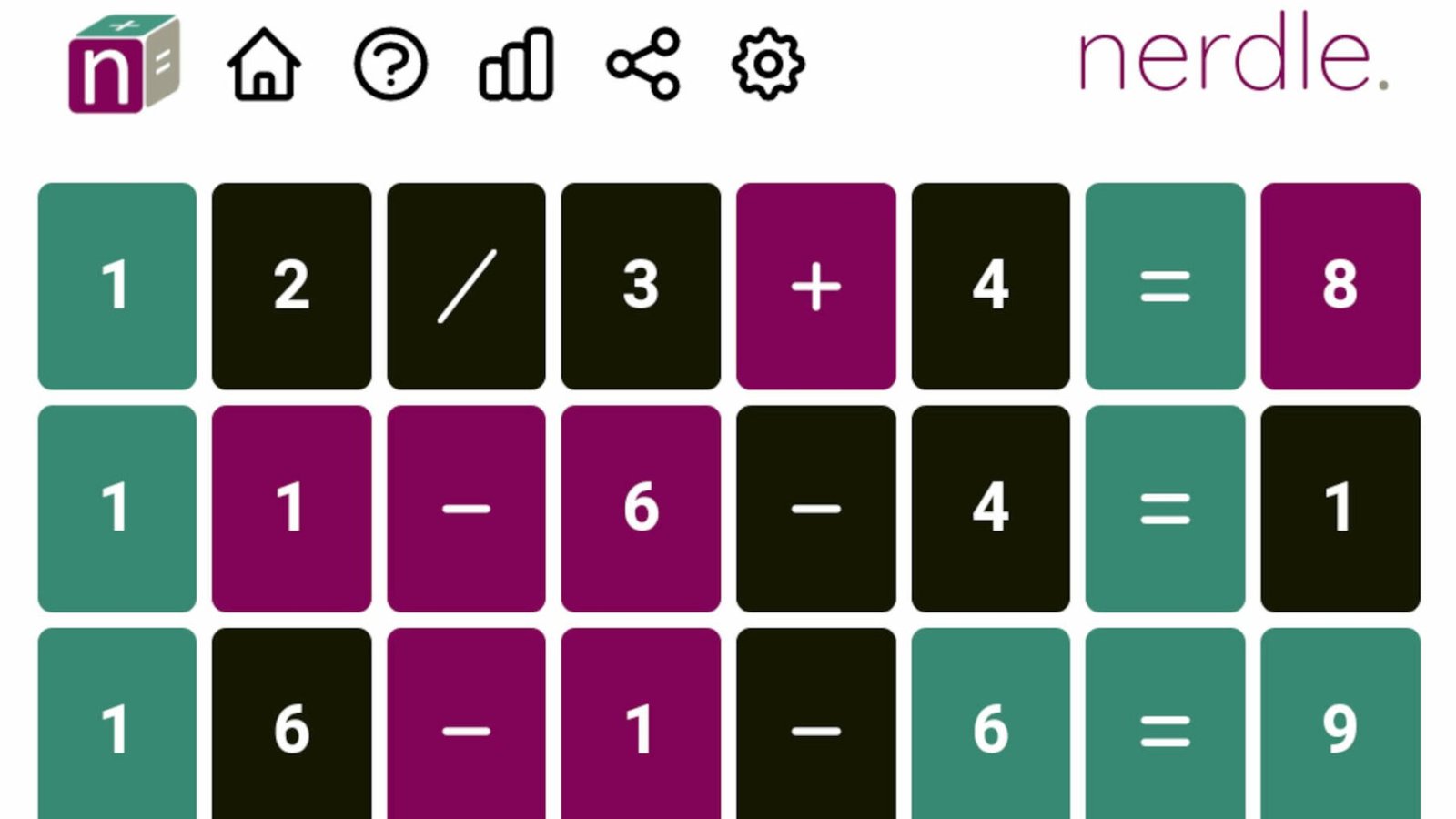
Use Color Feedback Strategically: Green tiles confirm correct placement, purple tiles indicate correct elements in wrong positions, and black tiles eliminate possibilities. Analyze this feedback systematically to narrow down possibilities efficiently.
Consider Number Frequency: Some digits appear more frequently in mathematical equations than others. Numbers like 1, 2, 5, and 0 often play important roles, while 7 and 8 might appear less frequently.
Advanced Solving Techniques
Pattern Recognition: Experienced solvers develop intuition about common equation patterns. Multiplication tables, perfect squares, and familiar arithmetic facts become second nature, allowing rapid identification of likely solutions.
Constraint Analysis: Each puzzle format imposes specific constraints. Classic equations must use exactly eight characters, while Mini equations use six. Understanding these limitations helps eliminate impossible solutions early.
Systematic Elimination: Use failed guesses to systematically eliminate numbers and operations from consideration. If a guess reveals that 3 doesn’t appear anywhere in the solution, exclude it from all future attempts.
Educational Applications and Variations
Nerdle’s educational potential extends far beyond entertainment. Mathematics educators increasingly incorporate Nerdle-style puzzles into curriculum planning, using the game’s engaging format to reinforce arithmetic concepts and problem-solving strategies.
Custom Nerdle variations allow teachers to create puzzles targeting specific mathematical concepts. A lesson on fractions might feature custom equations involving fractional operations, while geometry units could incorporate area and perimeter calculations.
Community-created Nerdle variations demonstrate the format’s flexibility. Players have developed themed puzzles around historical dates, scientific constants, and cultural celebrations, expanding the game’s educational and entertainment value.
Private Nerdle games enable family challenges and friend competitions, fostering mathematical discussions and friendly rivalry around daily puzzle solving.
Adaptive difficulty modes help players gradually improve their skills by adjusting puzzle complexity based on performance history. Beginning players can build confidence with simpler equations before tackling more complex challenges.
Building Your Nerdle Community
Nerdle’s social aspects contribute significantly to its popularity. Players share results using emoji grids that reveal their solving patterns without spoiling solutions for others. This creates a global community of puzzle enthusiasts who celebrate successes and offer encouragement during challenging puzzles.
Social media platforms buzz daily with Nerdle discussions, strategy sharing, and friendly competitions. Players compare solve times, analyze particularly difficult puzzles, and share insights about effective strategies.
Educational communities have embraced Nerdle as a tool for making mathematics more engaging. Teachers report increased student interest in arithmetic when Nerdle-style activities supplement traditional instruction methods.
Frequently Asked Questions
What is Nerdle?
Nerdle is a math-based puzzle game inspired by Wordle where players guess mathematical equations instead of words. The game provides color-coded feedback to help players deduce the correct calculation.
How do I play Nerdle?
Players arrange numbers and mathematical symbols to create valid equations. Each guess must be mathematically correct, and the game provides feedback through colored tiles indicating correct elements and positions.
Are there different versions of Nerdle?
Yes, Nerdle offers multiple variations: Classic (8 characters), Mini (6 characters), Micro (5 characters), and Maxi (11 characters), each providing different levels of challenge and complexity.
Where can I play Nerdle?
Nerdle is available online through the official Nerdle website at nerdlegame.com. New puzzles launch daily at 12am GMT across all time zones.
Can I create custom Nerdle puzzles?
Yes, the platform offers options for creating private games where you can challenge friends or family with custom equations tailored to specific difficulty levels or mathematical concepts.
How can I improve my Nerdle skills?
Practice regularly with all game variations, analyze solutions from past puzzles, develop systematic guessing strategies, and strengthen your mental arithmetic abilities. Study common mathematical relationships and number patterns that frequently appear in puzzles.
Master Your Mathematical Mind
September 16, 2025’s Nerdle puzzles demonstrate the beautiful diversity of mathematical thinking required to excel at this engaging game. From the multiplication mastery of Classic mode to the fundamental properties explored in Micro format, each puzzle offers unique insights into mathematical relationships and problem-solving strategies.
The solutions we’ve explored today—50 * 6 = 300, 15 – 6 = 9, 5 / 1 = 5, and 7² – 9 + 26 = 66—represent different aspects of mathematical knowledge and strategic thinking. Success in Nerdle comes from combining solid arithmetic foundations with logical deduction skills and pattern recognition abilities.
Whether you solved today’s puzzles easily or found them challenging, remember that improvement comes through consistent practice and strategic analysis. Each daily puzzle offers opportunities to strengthen your mathematical intuition while enjoying the satisfaction of logical problem-solving.
Ready to tackle tomorrow’s mathematical challenges? Visit the official Nerdle website and continue building your puzzle-solving prowess with each new day’s equations.
Nerdle Today: Complete Guide to September 15, Nerdle #1335
