
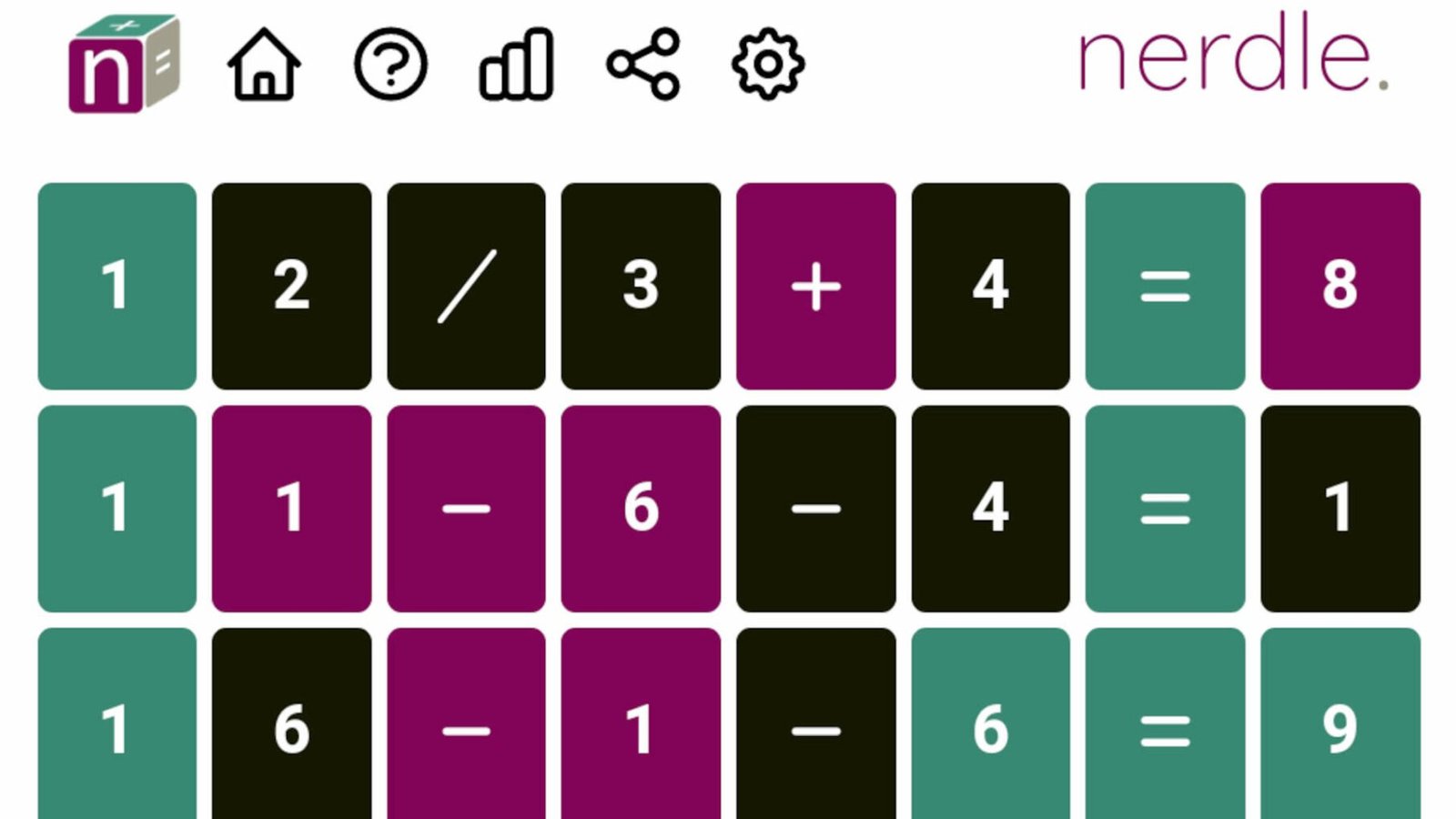
Mathematical puzzle games have captured the hearts of millions worldwide, and Nerdle stands at the forefront of this engaging trend. If you’re here searching for today’s Nerdle answer or looking to sharpen your puzzle-solving skills, you’ve come to the right place. This comprehensive guide will walk you through everything you need to know about Nerdle today, including the solution to puzzle #1337, effective strategies, and tips to master this addictive math game.
Whether you’re a seasoned Nerdle player or just discovering this mathematical twist on word puzzles, understanding the game’s mechanics and developing solid solving strategies can transform your daily puzzle experience. Let’s dive into the world of numbers, equations, and logical thinking that makes Nerdle such a compelling daily challenge.
What is Nerdle? Understanding the Mathematical Puzzle Phenomenon
Nerdle represents a brilliant fusion of mathematics and puzzle-solving that has captivated players across the globe. Created as a mathematical counterpart to the popular word game Wordle, Nerdle challenges players to guess a hidden equation using numbers and mathematical operators within six attempts.
The game’s premise is elegantly simple yet intellectually stimulating. Players must identify an eight-character equation that follows standard mathematical order of operations. Each guess provides feedback through a color-coded system: green indicates correct numbers or symbols in the right position, purple shows correct elements in wrong positions, and black reveals incorrect elements altogether.
What sets Nerdle apart from other puzzle games is its educational value. Unlike word games that rely primarily on vocabulary and pattern recognition, Nerdle requires players to engage with mathematical concepts, reinforcing arithmetic skills while providing entertainment. This unique combination has made it particularly popular among educators, students, and anyone looking to exercise their mathematical reasoning abilities.
The game’s popularity stems from its perfect balance of accessibility and challenge. Basic arithmetic knowledge is sufficient to start playing, yet the strategic thinking required to solve puzzles efficiently keeps even mathematics enthusiasts engaged. This broad appeal has contributed to Nerdle’s rapid growth and dedicated community of daily players.
Nerdle Today Answer: September 17, 2025, Puzzle #1337
Today’s Nerdle solution for puzzle #1337 is: 72÷8=9
This equation demonstrates a straightforward division problem that follows Nerdle’s standard format. The solution showcases how effective puzzle design can create satisfying “aha” moments when players recognize the mathematical relationship between the numbers.
For players who solved today’s puzzle, congratulations on your mathematical prowess! If you’re still working through it or want to understand the solving process better, the following section will provide a detailed walkthrough of how to approach and solve this particular Nerdle puzzle.
Step-by-Step Solution Guide for Puzzle #1337
Successfully solving today’s Nerdle requires systematic thinking and strategic number placement. Here’s how you might approach puzzle #1337:
Starting Your First Guess
When beginning any Nerdle puzzle, consider starting with common mathematical combinations. For today’s puzzle, many players might begin with equations involving familiar multiplication or division facts. A good starting guess could be something like “12+34=46” or “15-7=8” to test common numbers and operators.
Analyzing the Feedback
After your first guess, examine the color feedback carefully. Green squares indicate correct elements in proper positions, while purple squares show correct numbers or operators that belong elsewhere in the equation. Black squares eliminate possibilities, helping narrow your focus.
Working Toward the Solution
For puzzle #1337, players who started with division-focused guesses had an advantage. Recognizing that 72÷8=9 fits the pattern requires understanding basic division facts and considering how single-digit results can complete eight-character equations.
The Final Revelation
Once you identify the correct relationship—that 72 divided by 8 equals 9—the solution becomes clear. This equation represents a fundamental division fact that many players recognize from elementary mathematics, making the solving moment particularly satisfying.
Advanced Strategies and Tips for Mastering Nerdle
Developing consistent success with Nerdle requires more than mathematical knowledge; it demands strategic thinking and pattern recognition skills. Here are proven strategies that can improve your solving efficiency:
Strategic Opening Moves
Your first guess sets the tone for the entire puzzle. Experienced players often start with equations containing common numbers like 1, 2, 5, and 10, along with basic operators. Equations such as “10+2=12” or “15÷5=3” can reveal valuable information about number placement and operator usage.
Understanding Mathematical Patterns
Nerdle solutions follow specific mathematical rules and patterns. Familiarizing yourself with common arithmetic facts, such as multiplication tables, perfect squares, and simple division relationships, provides a foundation for recognizing potential solutions quickly.
Operator Strategy
Each mathematical operator—addition, subtraction, multiplication, and division—appears with varying frequency in Nerdle puzzles. Understanding when to test specific operators based on the numbers you’ve identified can significantly reduce your solving time.
Position Analysis
Pay attention to where numbers and operators typically appear in equations. The equals sign often appears in positions 6 or 7 in eight-character equations, while certain numbers are more likely to appear as results versus operands.
Elimination Techniques
Use black-square feedback strategically to eliminate entire categories of possibilities. If you know certain numbers don’t appear in the solution, focus your remaining guesses on equations that avoid those numbers entirely.
The Psychology Behind Nerdle’s Appeal
The enduring popularity of Nerdle and similar mathematical puzzles stems from several psychological factors that make these games intrinsically rewarding. Understanding why we enjoy these challenges can enhance your appreciation for the game itself.
Cognitive Satisfaction
Solving mathematical puzzles triggers the brain’s reward centers, providing a sense of accomplishment that comes from logical problem-solving. This neurological response explains why many players describe Nerdle solutions as satisfying or even addictive.
Pattern Recognition Rewards
Humans are naturally drawn to pattern recognition, and Nerdle provides a perfect outlet for this cognitive tendency. The game rewards players who can identify mathematical relationships and number patterns, satisfying our innate desire to find order in complexity.
Educational Engagement
Unlike purely entertainment-focused games, Nerdle offers guilt-free engagement by reinforcing mathematical skills. Players feel productive while enjoying themselves, creating a positive association with mathematical thinking.
Social Connection
The shared daily puzzle format creates a sense of community among players. Discussing strategies, sharing results, and comparing solving approaches fosters social connections around mathematical problem-solving.
Exploring Nerdle Variations: Mini, Bi, and Pro Nerdle
The original Nerdle game has spawned several engaging variations that cater to different skill levels and preferences. Each variant offers unique challenges while maintaining the core mathematical puzzle-solving experience.
Mini Nerdle
Mini Nerdle compresses the challenge into a six-character equation format, requiring players to solve shorter mathematical expressions. This variation is perfect for quick brain exercises or players who prefer faster-paced puzzle-solving sessions.
The condensed format doesn’t necessarily make Mini Nerdle easier—it simply changes the strategic approach. With fewer characters available, every guess carries more weight, requiring more precise thinking and efficient number usage.
Bi Nerdle
Bi Nerdle presents players with two simultaneous equations to solve, doubling the challenge and complexity. This variation appeals to advanced players seeking greater difficulty and mental stimulation.
Success in Bi Nerdle requires managing information across both equations simultaneously, often using clues from one equation to inform guesses about the other. This cross-equation strategy adds layers of complexity that serious puzzle enthusiasts appreciate.
Pro Nerdle
Pro Nerdle incorporates advanced mathematical concepts, including fractions, exponents, and more complex operations. This variation serves players with strong mathematical backgrounds who want more sophisticated challenges.
Pro Nerdle puzzles might include equations involving square roots, parentheses for order of operations, or multi-step calculations that require advanced mathematical reasoning. This variation truly tests players’ mathematical knowledge and problem-solving capabilities.
Building Community Through Mathematical Puzzles
The Nerdle community represents one of the most positive aspects of mathematical gaming culture. Players from diverse backgrounds unite around their shared love of numerical problem-solving, creating supportive environments for learning and improvement.
Sharing Strategies
Online forums, social media groups, and dedicated websites facilitate strategy discussions among Nerdle players. These communities share solving techniques, discuss particularly challenging puzzles, and celebrate mathematical discoveries together.
Educational Impact
Teachers and educators have embraced Nerdle as a classroom tool, using daily puzzles to reinforce mathematical concepts and encourage problem-solving skills. The game’s format makes it suitable for various educational settings and age groups.
Global Participation
Nerdle’s universal mathematical language transcends cultural and linguistic barriers, allowing players worldwide to participate equally. This global accessibility has contributed to the game’s international popularity and diverse player base.
Enhancing Your Daily Nerdle Experience
Maximizing your enjoyment and success with Nerdle involves developing consistent habits and approaches that support both learning and entertainment goals.
Establishing Routine
Many successful players incorporate Nerdle into their daily routines, treating it as a mental warm-up exercise or midday brain break. This consistency helps maintain mathematical sharpness while providing reliable daily entertainment.
Learning from Mistakes
Each failed guess provides valuable information for future puzzles. Analyzing unsuccessful attempts helps identify common mistakes and develop better strategic approaches for similar mathematical relationships.
Tracking Progress
Maintaining awareness of your solving patterns, success rates, and preferred strategies helps identify areas for improvement. Many players keep informal records of their favorite solving techniques and particularly challenging puzzles.
The Future of Mathematical Puzzle Gaming
Nerdle’s success has paved the way for continued innovation in mathematical gaming, suggesting exciting possibilities for future developments in educational puzzle design.
Technological Integration
Future versions of Nerdle might incorporate adaptive difficulty systems, personalized challenge levels, or integration with educational platforms. These technological enhancements could make mathematical puzzle-solving even more engaging and educationally effective.
Expanded Mathematical Concepts
As the game evolves, we might see variations incorporating geometry, algebra, calculus, or other mathematical fields. These expansions would cater to specialized mathematical interests while maintaining the accessible core gameplay.
Community Features
Enhanced social features, collaborative solving modes, or competitive tournaments could further strengthen the Nerdle community while introducing new ways to engage with mathematical problem-solving.
Frequently Asked Questions About Nerdle
Nerdle publishes one new puzzle daily, creating a consistent challenge schedule that players can incorporate into their routines. Each puzzle remains available for 24 hours before being replaced with a new mathematical equation.
The official Nerdle game focuses on daily puzzles, but various websites and applications offer archives of previous puzzles for additional practice. These resources help players improve their skills by working through historical challenges.
Basic arithmetic operations—addition, subtraction, multiplication, and division—provide sufficient mathematical background for most Nerdle puzzles. Understanding order of operations and common mathematical facts enhances solving efficiency.
While the official game doesn’t provide hints, various online communities offer strategy discussions and gentle guidance for challenging puzzles. These resources maintain the game’s integrity while supporting struggling players.
Improving Nerdle performance requires practicing strategic first guesses, memorizing common mathematical facts, and developing systematic approaches to analyzing feedback. Regular play naturally enhances pattern recognition and solving efficiency.
Master the Mathematical Challenge
Nerdle represents more than just a daily puzzle—it’s a gateway to mathematical thinking that combines entertainment with education. Today’s puzzle #1337 demonstrates how elegant mathematical relationships can create satisfying problem-solving experiences that engage both beginners and experts.
The beauty of Nerdle lies in its ability to make mathematics approachable and enjoyable. Each daily puzzle offers an opportunity to exercise numerical reasoning, discover mathematical patterns, and experience the satisfaction of logical problem-solving. Whether you solved today’s puzzle quickly or needed all six guesses, the important thing is engaging with mathematical thinking in a fun, low-pressure environment.
As you continue your Nerdle journey, remember that improvement comes through consistent practice and strategic thinking. Each puzzle teaches valuable lessons about mathematical relationships, problem-solving approaches, and logical reasoning. These skills extend far beyond the game itself, enhancing mathematical confidence and analytical thinking in daily life.
Looking to catch up on previous puzzles? Check out our detailed walkthrough for Nerdle puzzle #1336 from September 16, 2025, to refine your strategy further. If you’re curious about earlier challenges, don’t miss our guide to puzzle #1335 from September 15, 2025, complete with solutions and expert tips to elevate your Nerdle game.
